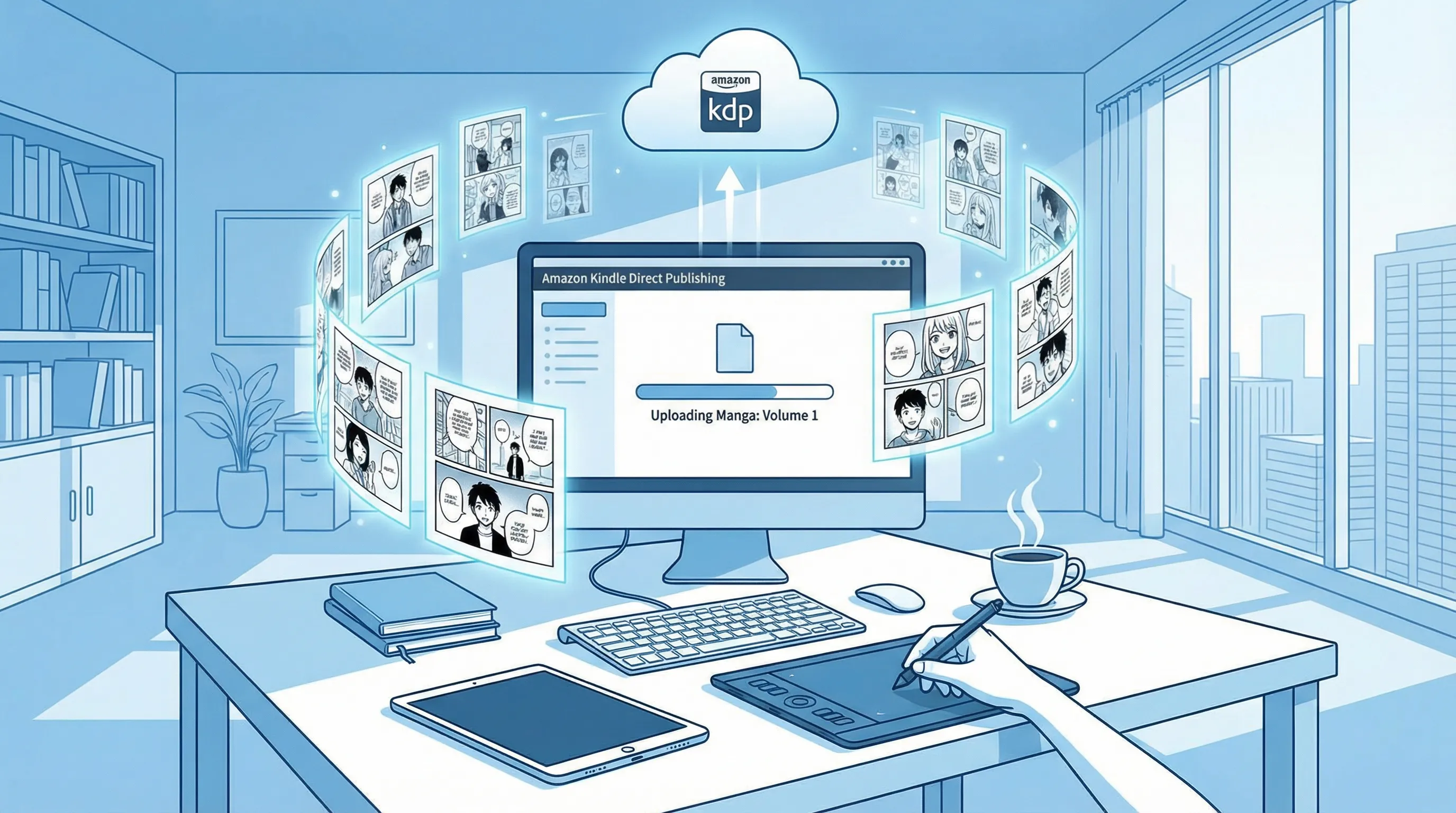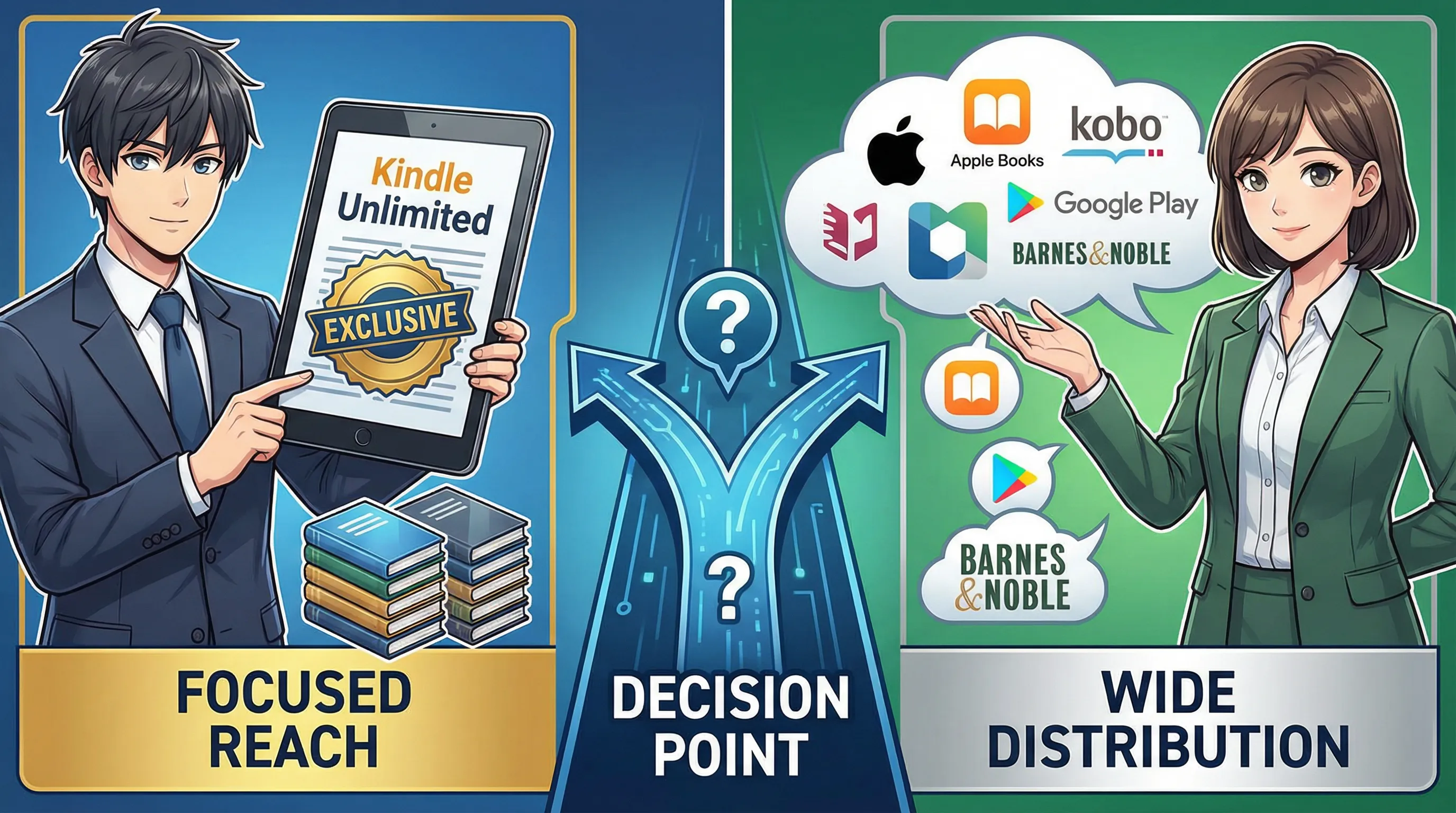
The choice between Kindle Unlimited exclusivity and wide distribution represents one of the most consequential decisions in manga publishing. This strategic fork determines not only where readers discover your manga, but fundamentally shapes your revenue model, marketing approach, and long-term business trajectory. While Amazon KDP Select offers the allure of Kindle Unlimited page reads and promotional tools, wide distribution promises broader reach and platform diversification. For AI manga creators using tools like Anifusion, this decision impacts both immediate earnings and sustainable income growth.
Table of Contents
Understanding KDP Select and Kindle Unlimited
KDP Select is Amazon's exclusivity program requiring authors to grant Amazon exclusive digital distribution rights for 90-day renewable periods. In exchange, enrolled manga becomes available in Kindle Unlimited (KU), Amazon's subscription reading service where readers pay $11.99 monthly for unlimited access to over 4 million titles.
The economics of KU differ fundamentally from traditional sales. Instead of earning a fixed royalty per sale, you earn from the KU Global Fund based on pages read. Amazon calculates normalized pages (KENP) and distributes monthly fund totals (typically $35-40 million) proportionally among all page reads that month.
Current KU payout rates hover around $0.0045-$0.0050 per page read. A 120-page manga earning 1,000 complete reads generates approximately $540-$600 monthly from KENP alone, before adding any direct sales.
Wide Distribution: The Multi-Platform Approach
Wide distribution means making your manga available across multiple ebook platforms simultaneously. Primary platforms for manga include Amazon KDP (without KDP Select enrollment), Apple Books, Kobo, Google Play Books, and Barnes & Noble Nook. Wide distribution advantages include platform diversification, international market access, reader preference accommodation, no exclusivity constraints, and permanent availability.
The wide distribution revenue model relies on cumulative sales across platforms rather than page reads. A manga priced at $4.99 earns approximately $3.49 from Amazon, $3.50 from Apple Books, $3.49 from Kobo, and similar amounts from other platforms—all from the same title simultaneously.
Revenue Analysis: KU vs. Wide in Real Numbers
Understanding which strategy generates higher revenue requires analyzing actual performance data from manga publishers using both approaches. In typical scenarios, wide distribution can generate 25-75% higher revenue for premium, collectible, or educational manga, while romance, fantasy, and isekai manga typically perform better in KU due to higher page read to sales ratios.
Genre-specific performance patterns show that consumable entertainment content favors KU, while reference, collectible, or premium content favors wide distribution.
The Testing Framework: Finding Your Optimal Strategy
Rather than guessing which approach works for your specific manga, implement a data-driven testing framework. Phase 1: Initial KU Test (Days 1-90) - Publish exclusively in KDP Select for baseline KU performance data. Phase 2: Wide Distribution Test (Days 91-180) - Opt out and publish wide across all major platforms. Phase 3: Strategic Decision (Day 181+) - Make your strategic decision based on real revenue data from both approaches.
Return to KU if KENP revenue exceeded 40% during Phase 1, or stay wide if wide revenue exceeded KU revenue by 25%+.
Anifusion's Strategic Advantages Across Both Models
Anifusion's AI manga generation capabilities provide unique advantages regardless of which distribution strategy you choose. For KU-exclusive strategy, Anifusion enables rapid series production, page count optimization, and character consistency across series. For wide distribution strategy, Anifusion supports multi-platform formatting, international appeal, and premium positioning. For hybrid strategies, Anifusion enables A/B testing at scale, series starters in KU with sequels wide, and seasonal strategy rotation.
Platform-Specific Optimization Strategies
Success in either model requires understanding platform-specific optimization. For Amazon KDP, categories matter enormously—manga in 5-7 categories has exponentially more discovery opportunities. Keywords drive search traffic—use all 350 characters with long-tail phrases. For Apple Books, editorial relationships matter and Japanese market access requires local bank account but opens massive opportunities. For Kobo, participate actively in Kobo Writing Life promotions and focus on Canadian and European markets.
The Hybrid Strategy: Best of Both Worlds
Advanced manga publishers increasingly adopt hybrid strategies that leverage both KU and wide distribution advantages. Strategy 1: Staggered Release Windows - Launch new manga in KDP Select for initial 90 days, then go wide. Strategy 2: Format Splitting - Enroll standard editions in KDP Select while distributing expanded editions wide. Strategy 3: Genre-Based Portfolio Allocation - Keep quick-read genre manga in KU while distributing premium manga wide. Strategy 4: Test-Then-Optimize - Publish first volume in KU to test market fit, then optimize based on results.
Conclusion
Your distribution strategy isn't a permanent decision—it's an ongoing optimization process. As your catalog grows, audience develops, and market conditions change, revisit your strategy quarterly to ensure you're maximizing revenue potential across all available channels. The creators earning $3,000-$5,000+ monthly typically test both approaches, analyze data objectively, and optimize individually for each manga rather than forcing portfolio-wide uniformity. Start with a systematic testing plan, gather empirical data, and make informed decisions based on your specific manga's performance.
Frequently Asked Questions
Should I publish my manga in Kindle Unlimited or go wide?
Test both strategies systematically. Start with 90 days in KDP Select to measure Kindle Unlimited page read revenue. If KENP earnings exceed 40% of total revenue, KU typically maximizes income. If under 25%, wide distribution usually generates higher overall earnings. Genre matters: romance, fantasy, and isekai manga perform better in KU, while seinen, educational, and collectible manga perform better wide.
How much can I earn from Kindle Unlimited page reads?
Kindle Unlimited pays approximately $0.0045-$0.0050 per page read (KENP) as of 2025. A 120-page manga earns $0.54-$0.60 per complete read. If 1,000 KU subscribers read your manga fully, you earn $540-$600 from page reads alone, equivalent to selling 162-180 copies at $3.99. High-performing manga in popular genres often see 5,000-20,000 monthly page reads, generating $225-$1,000 just from KU.
What are the advantages of wide distribution over Kindle Unlimited?
Wide distribution offers: 1) Platform diversification protecting against algorithm changes, 2) Access to international markets where Apple Books and Kobo dominate, 3) Higher per-sale revenue without KU cannibalization, 4) No exclusivity constraints allowing Patreon, website sales, and partnerships, 5) Reaching readers who prefer non-Amazon platforms. Wide typically generates 25-75% higher revenue for premium, collectible, or educational manga.
Can I switch between Kindle Unlimited and wide distribution?
Yes. KDP Select enrollment lasts 90 days and auto-renews unless you opt out 3 days before renewal. You can test KU for 90 days, then go wide by opting out and publishing to other platforms. Or reverse: go wide initially, then enroll in KDP Select later (requires unpublishing from all other platforms first). Many publishers alternate strategies every 90 days or use hybrid approaches—keeping some manga in KU while distributing others wide.
Which platforms should I publish on if I go wide?
Essential platforms for manga: Amazon KDP (non-exclusive), Apple Books, Kobo, and Google Play Books. These four represent 95%+ of wide distribution revenue. Optional additions: Barnes & Noble Nook, Draft2Digital (aggregator), and regional platforms. Focus on the big four initially—adding more platforms later once you establish workflow. Use aggregators like Draft2Digital to distribute to smaller retailers efficiently without managing multiple accounts.